Bun vs Node.js: Is This the Future of JavaScript Backend?

- Published on
The JavaScript backend ecosystem has been remarkably stable for over a decade. Node.js, released in 2009, set the standard for server-side JavaScript and maintained it through the rise of microservices, serverless functions, and edge computing. npm became the largest package registry in the world. The toolchain grew around it: Webpack, Babel, Jest, ESLint, TypeScript compilers, each solving a problem Node itself did not address.
Bun does not enter this ecosystem with a single improvement. It enters with a different premise entirely: what if the entire toolchain was one thing, built from scratch for speed?
After evaluating Bun across production-grade use cases, here is what the technical reality looks like for backend engineers making decisions today.
1. What Bun Actually Is
Most coverage of Bun leads with benchmark numbers. To understand why those numbers matter, it helps to understand the architectural decision that produces them.
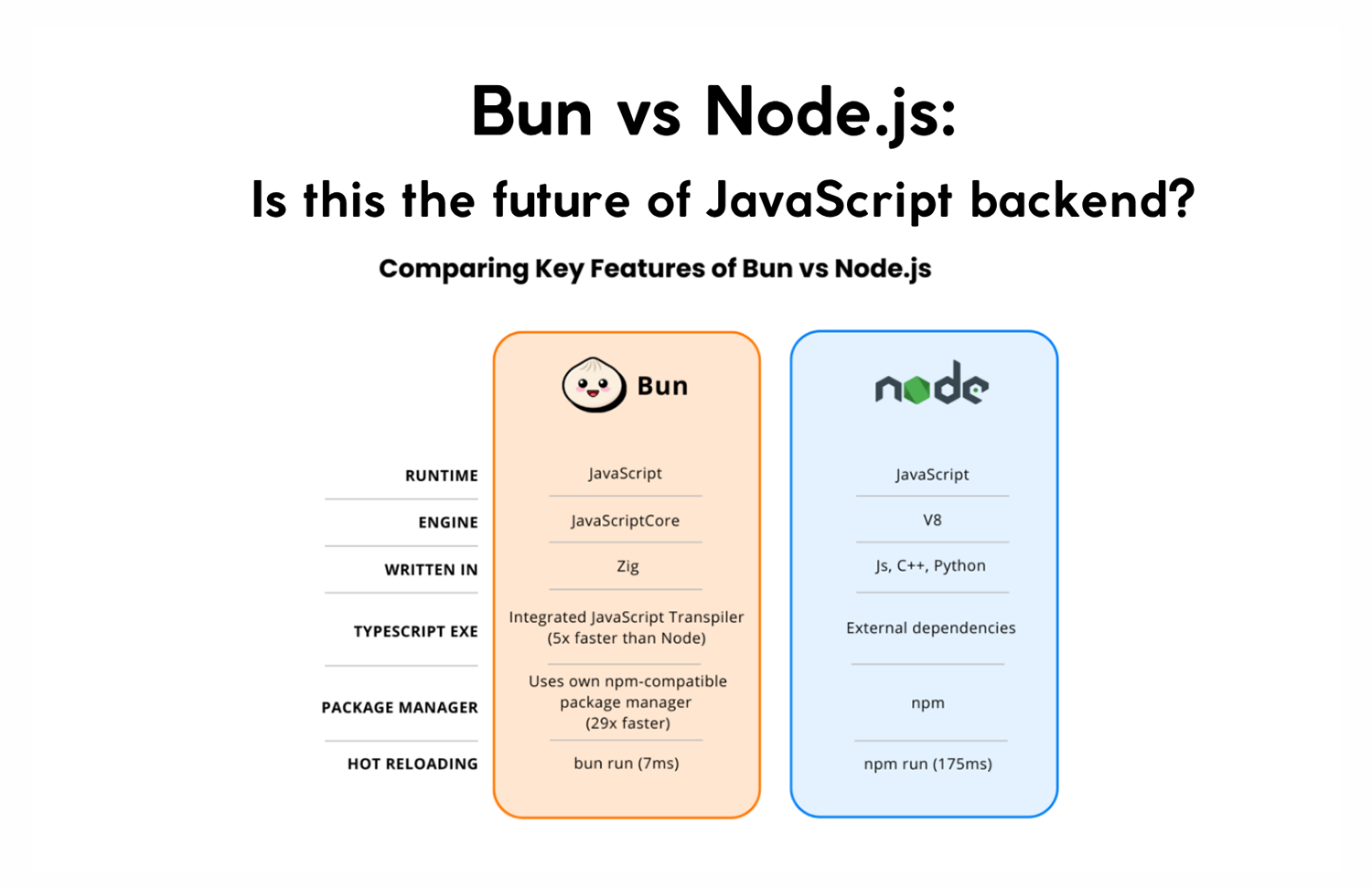
Node.js is built on V8, Google's JavaScript engine. Bun is built on JavaScriptCore, the engine that powers Safari, developed by Apple. JavaScriptCore has different performance characteristics than V8, particularly around startup time and memory usage at cold start. For long-running server processes, the difference narrows. For short-lived processes like serverless functions, scripts, or CLI tools, it is significant.
Beyond the engine, Bun is written in Zig, a systems programming language designed for performance and explicit memory control. This allows Bun to implement its I/O layer, HTTP server, and standard library with significantly less overhead than Node's C++ and libuv stack.
The result is a runtime that is genuinely faster at the operations that dominate JavaScript backend workloads: HTTP request handling, file I/O, and process startup.
But the runtime is only part of what Bun ships.
2. The Toolchain Problem Bun Is Actually Solving
To understand Bun's value proposition, consider what a typical Node.js project requires before you write a single line of application code:
Node.js runtime          → execute JavaScript
npm / yarn / pnpm        → install dependencies
TypeScript compiler      → transpile TS to JS
ts-node or tsx           → run TS files directly
Babel                    → transpile modern JS for compatibility
Webpack / esbuild / Vite → bundle for production
Jest / Vitest            → run tests
nodemon / ts-node-dev    → hot reload during development
Each of these tools has its own configuration format, its own version to pin, its own compatibility surface with every other tool. A non-trivial amount of engineering time in JavaScript projects goes into maintaining this toolchain rather than building the product.
Bun ships all of this as a single binary:
- Runtime: execute JavaScript and TypeScript natively, no compilation step
- Package manager: install dependencies from the npm registry, faster than npm, yarn, or pnpm
- Bundler: bundle for production with performance comparable to or faster than esbuild
- Test runner: run tests with a Jest-compatible API via
bun:test
This is not a convenience feature. It is a structural reduction in accidental complexity.
3. Performance: What the Numbers Actually Mean
Bun's benchmark numbers are real and they are significant. But the context matters for how you apply them to real engineering decisions.
Startup time: Bun starts approximately 4x faster than Node.js on cold starts. For serverless functions billed by invocation duration, or for CLI tools where startup latency is user-visible, this is a material difference. For a long-running HTTP server that starts once and runs for days, it is largely irrelevant.
HTTP throughput: In HTTP server benchmarks, Bun handles significantly more requests per second than Node.js with Express. The gap narrows when you add application logic, database queries, and realistic middleware stacks. For I/O-bound workloads, the difference is meaningful. For CPU-bound workloads, the bottleneck shifts to the application logic itself.
Package installation: bun install is measurably faster than npm, yarn, and pnpm on most dependency graphs. This improves CI pipeline times and local development ergonomics. It is not a production runtime concern, but it accumulates to real time saved across a team.
Test execution: bun:test runs Jest-compatible test suites faster than Jest itself, primarily because it eliminates the Node.js startup and module loading overhead that Jest pays on every run.
The honest framing: Bun is faster where it matters for serverless, edge, CLI tooling, and developer feedback loops. For traditional long-running Node.js servers, the runtime performance gap is real but often not the bottleneck.
4. TypeScript Support Without Configuration
Native TypeScript support is one of the most practically significant features Bun ships, and it is consistently undersold in benchmark-focused coverage.
In Node.js, running TypeScript requires a compilation step. You either compile with tsc and run the output, or use a loader like ts-node, tsx, or esbuild-register that transpiles on the fly. Each approach adds configuration, adds a dependency, and adds a layer that can diverge from your production build.
Bun executes TypeScript files directly:
bun run server.ts
No tsconfig changes for execution. No separate compilation step. No loader configuration. The file runs.
This does not replace tsc for type checking. Bun does not type-check at runtime, it strips types and executes. For production workflows, you still want tsc --noEmit in your CI pipeline. But the development loop becomes dramatically simpler, and for many teams that is where TypeScript friction is highest.
5. CommonJS and ESM: The Module System Problem Bun Solves
One of the most persistent sources of friction in the Node.js ecosystem is the coexistence of CommonJS and ESM. Packages use different module systems. Configuration requires specifying "type": "module" or .mjs extensions. Mixing the two in a single project requires careful management and sometimes explicit interop layers.
Bun supports both CommonJS and ESM natively, in the same file if needed, without configuration. require() and import both work. Mixed-module dependencies resolve without explicit interop configuration.
For teams migrating existing Node.js projects to ESM, or for projects that depend on a mix of legacy CommonJS packages and modern ESM packages, this eliminates a significant category of configuration complexity.
6. Hot Reloading Without Process Restart
Bun implements hot reloading at the module level rather than restarting the entire process. When a file changes, Bun re-evaluates only the changed module and its dependents, preserving application state that is not affected by the change.
In practice, this means the development feedback loop is faster and in-memory state (open connections, cached data, initialized services) survives file changes. For complex applications with meaningful initialization time, this is a real productivity improvement.
7. Where Node.js Still Wins
A balanced evaluation requires being direct about where Node.js has structural advantages.
Ecosystem maturity. The npm ecosystem was built for Node.js. The vast majority of packages are tested against Node.js. Most will work with Bun, but compatibility is not universal, particularly for packages with native addons or that rely on Node-specific internals. For enterprise environments with large dependency graphs, this is a real risk.
Production track record. Node.js has been running mission-critical workloads at companies like Netflix, LinkedIn, Uber, and PayPal for over a decade. Its failure modes are documented, its performance characteristics are understood, and its operational tooling is mature. Bun's production history is measured in months, not years.
Tooling and observability. APM tools, profilers, debuggers, and deployment platforms have deep Node.js integration. Bun compatibility is improving but not yet at parity. For teams that rely on specific observability tooling, verify compatibility before committing.
Team familiarity. The operational and debugging knowledge your team has accumulated around Node.js has real value. Switching runtimes has a learning and migration cost that benchmarks do not capture.
8. When to Use Bun Today
Based on a practical assessment of where Bun's advantages are structural and where its risks are manageable:
Strong fit:
- New projects without existing Node.js investment
- Serverless functions and edge workers where cold start latency matters
- CLI tooling where startup speed is user-visible
- TypeScript-first projects where eliminating the compilation step simplifies the development loop
- Teams that want to consolidate the JavaScript toolchain and reduce configuration surface area
- Projects with relatively shallow dependency graphs
Proceed carefully:
- Applications with dependencies on native Node addons
- Environments where specific APM or observability tooling requires Node.js
- Teams already running stable Node.js production systems with high traffic
Not the right time:
- Legacy projects with large, complex dependency graphs where compatibility risk is high
- Regulated environments where runtime maturity and audit history are compliance requirements
9. The Broader Implication for the JavaScript Ecosystem
Bun's impact is not limited to the teams that adopt it directly.
The existence of a credible, high-performance alternative to Node.js is already influencing the Node.js project itself. Performance improvements, native TypeScript support discussions, and toolchain consolidation efforts in the Node.js roadmap are at least partially a response to the competitive pressure Bun creates.
This is how healthy ecosystems evolve. Bun is not here to kill Node.js. It is here to push the JavaScript ecosystem toward being faster, simpler, and less reliant on accumulated toolchain complexity.
For engineering leaders, the practical implication is that the gap between Node.js and the modern JavaScript toolchain ideal is narrowing on both sides. Bun is getting more production-ready. Node.js is getting faster and simpler. In two to three years, the choice between them will be more nuanced than it is today.
Conclusion
Bun v1.0 represents a genuine rethinking of what a JavaScript runtime should be in 2024 and beyond. The performance numbers are real. The TypeScript-native experience is meaningfully better than the Node.js status quo. The toolchain consolidation eliminates a real category of accidental complexity that costs engineering teams time.
It is not a Node.js replacement for most production systems today. The ecosystem maturity gap and the production track record difference are real constraints, not marketing spin.
But for new projects, serverless workloads, and teams that value development velocity and toolchain simplicity, Bun is a serious engineering choice, not an experiment.
The JavaScript backend ecosystem is not static. Bun's existence ensures it moves faster.
At JMS Technologies Inc., we evaluate and architect backend systems with a clear focus on performance, operational maturity, and long-term maintainability. Whether the stack is Node.js, Bun, or something else, the architecture decisions are what determine production outcomes.
Need to evaluate the right backend runtime for your platform? Let's talk.