The Hardest Part of Scaling Software Isn't the Code

- Published on
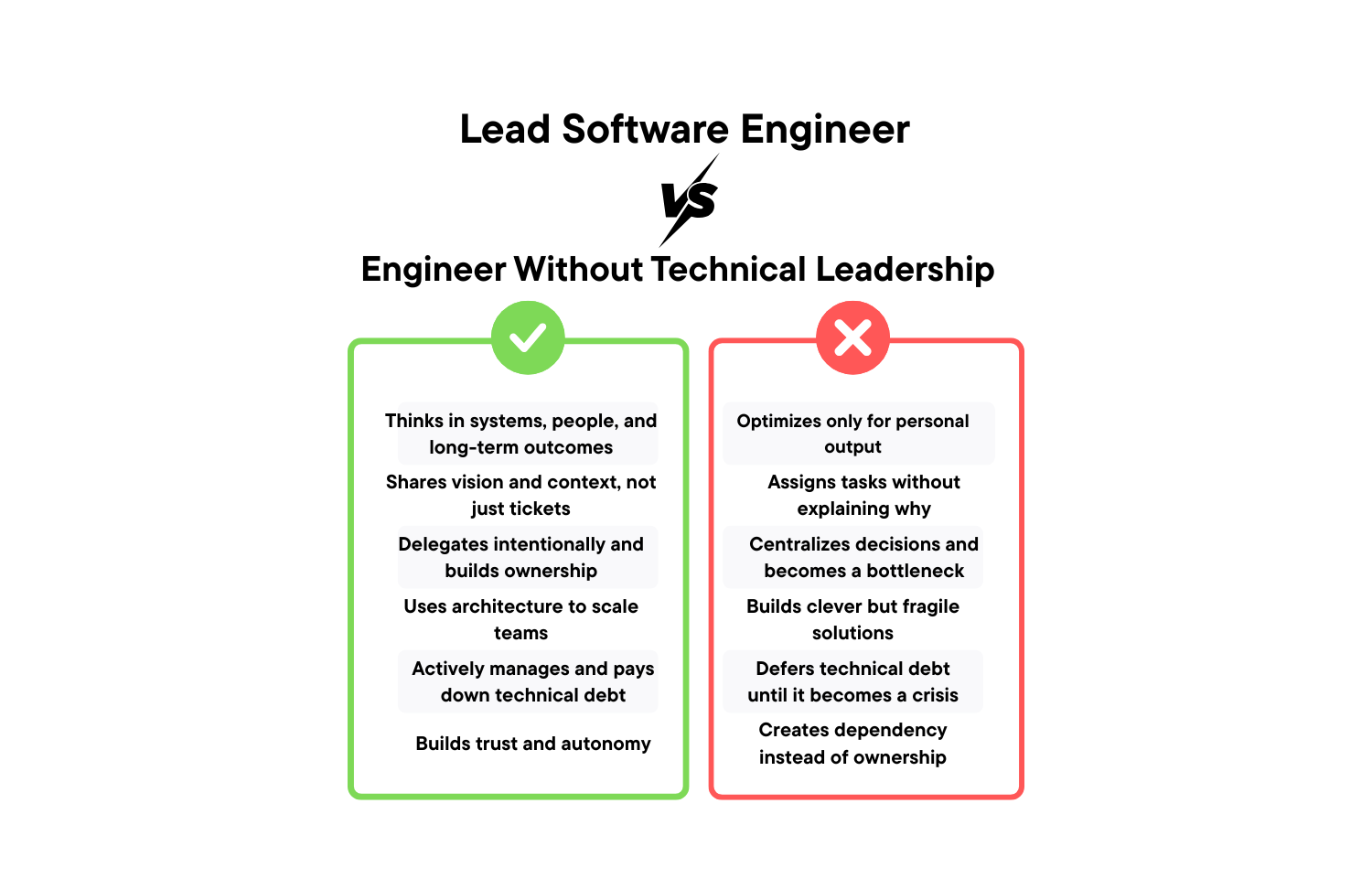
Every engineer who moves into technical leadership eventually hits the same wall.
You are handed a team. You have the technical knowledge. You know the codebase better than most. You have strong opinions about architecture, about code quality, about the right way to run a system. And then you discover that none of that knowledge translates directly into the thing you are now responsible for: getting a group of human beings to build something great together.
Leading a team of 40 developers across large-scale projects for companies like U.S. Bank was one of the most challenging and clarifying chapters of my engineering career. The systems we built were complex. The distributed architecture, the transaction volumes, the compliance requirements, all of it demanded serious technical judgment.
But the hardest problems were not in the code.
The hardest problems were human. And most engineering education prepares you thoroughly for the technical complexity and barely at all for the human complexity.
Here is what scaling software actually requires, from someone who has done it at scale.
1. The Transition From Contributor to Leader Is a Role Change, Not a Promotion
Most engineers enter technical leadership believing the job is to be the best engineer in the room who also manages people. That mental model is wrong, and holding onto it causes real damage.
When you are an individual contributor, your value is direct and measurable. You write code, design systems, debug failures. The output is visible. The feedback loop is short. The satisfaction is concrete.
When you lead 40 engineers, your value is indirect and often invisible. You create conditions. You remove friction. You ensure the people building have the context, the clarity, and the trust they need to build well. The good days are the ones where everything runs smoothly and nothing obviously needed you. Those are the days you did your job.
The shift is not from technical to non-technical. Senior technical leadership requires deep engineering judgment. But the primary application of that judgment changes: less time on the keyboard, more time listening, aligning, and removing friction. Less time solving problems yourself, more time ensuring the team can solve them without you.
Engineers who resist this shift remain effective individual contributors with a manager title. They become bottlenecks. Every important technical decision waits for them. The team stops developing ownership because ownership is never really given.
The transition requires letting go of the direct output loop. That is genuinely difficult for people who chose engineering because they find direct problem-solving satisfying. It is also necessary.
2. Trust Scales Better Than Any Framework
Large engineering teams require coordination mechanisms. Process, tooling, architecture standards, code review requirements. These exist for real reasons and should not be dismissed.
But the most effective coordination mechanism in a large engineering team is trust, and it is the one most engineering leaders underinvest in.
When trust exists between a leader and their team, decisions move faster. Engineers do not wait for explicit permission on judgment calls within their domain. They make the call, communicate it, and move forward. The review cycle still exists, but it is not the blocking dependency.
When trust exists between engineers on a team, knowledge sharing happens without process requiring it. Someone discovers a better approach and shares it because they want their colleagues to benefit, not because there is a learning requirement in the sprint.
When trust exists between teams, cross-team coordination is a conversation rather than a negotiation. Dependencies get surfaced early. Blockers get raised instead of hidden.
No microservice architecture, no project management framework, no DORA metric initiative produces these outcomes. Trust produces them. Trust is built through consistent behavior over time: following through on commitments, being honest about uncertainty, protecting the team when things go wrong, and giving credit when things go right.
The compounding effect of trust across a 40-person team is enormous. Its absence creates coordination overhead that no amount of process can compensate for.
3. Context Beats Task Lists
One of the most common failure modes in engineering management is running the team on task lists without shared context about why those tasks matter.
A developer implementing a feature from a JIRA ticket without understanding the business problem it solves will implement the literal requirement. A developer who understands the underlying problem will implement the requirement and notice when the literal implementation misses the actual need.
The difference in output quality between these two scenarios, across a team of 40 engineers, across hundreds of features over months of development, is enormous. It is the difference between a team that executes requirements and a team that solves problems.
Providing context requires more upfront investment from technical leaders. You have to understand the business problem well enough to explain it clearly. You have to connect engineering work to product outcomes. You have to create the space for engineers to ask why before they start building.
But the return on that investment compounds. Engineers with context make better technical decisions independently. They flag misalignments between requirements and goals before building the wrong thing. They take ownership of outcomes rather than just deliverables.
The best engineering teams I have been part of had leaders who treated context as infrastructure. Not a nice-to-have, but a prerequisite for quality work.
4. Technical Debt Always Accrues Interest
Every engineering leader eventually has to make the case for slowing down to address technical debt. And almost every time, that conversation is harder than it should be.
The reason is that technical debt has a deferred cost structure that makes it systematically undervalued in short-term planning. The decision to cut a corner today creates no immediate visible cost. The cost arrives later, when delivery slows, when a new feature requires rewriting a module that was never designed to be extended, when an outage traces back to a system that everyone knew was brittle but that nobody had prioritized fixing.
After enough years leading large engineering teams, the pattern becomes predictable. Teams that consistently defer debt reduction eventually reach a state where the interest payments consume more engineering capacity than new feature development. Velocity drops. Morale drops with it, because engineers who care about their craft find it demoralizing to work in systems they know are broken. Attrition follows.
The engineering leader's job is to make the cost of technical debt visible before it becomes a crisis. That means tracking it explicitly, quantifying its impact on delivery velocity where possible, and treating debt reduction as a first-class engineering investment rather than something that gets scheduled when there is capacity.
There is never capacity. You have to make capacity.
The teams that manage technical debt well are the ones where leadership treats it as seriously as feature work, not as something engineers sneak into sprints when nobody is watching.
5. Architecture Is a Collaboration Tool
At scale, architecture is not primarily a technical decision. It is an organizational one.
Conway's Law is not a curiosity. It is a predictable constraint on how large organizations build software. The architecture of your system will, over time, reflect the communication structure of the team that builds it. The inverse is also true and more actionable: you can use architecture to shape how teams collaborate.
Leading 40 engineers across multiple teams on a large-scale platform, one of the most valuable architectural decisions was the commitment to modular, domain-driven boundaries. Each team owned a bounded context. Interfaces between contexts were explicit contracts. Teams could move independently within their domain without requiring coordination with other teams for every change.
The technical benefits are well-understood: independent deployability, clear ownership, fault isolation. The organizational benefits are equally important but less often discussed.
Modular architecture reduces the coordination overhead that slows large teams. When a team owns a domain cleanly, they can make decisions, ship changes, and iterate without waiting for consensus across four other teams. The blast radius of a bad decision is contained. The speed of a good decision is maximized.
Atomic design at the component level achieves the same thing within a team: engineers can build independently, combine their work confidently, and ship without extensive coordination on implementation details.
Architecture, designed deliberately, is a tool for giving people autonomy without creating chaos. That is exactly what large engineering teams need.
6. Leadership Is About Creating Conditions, Not Providing Answers
The instinct of every technically strong person who moves into leadership is to be the person with answers. You have the experience. You have seen the failure modes. You know what will work.
That instinct, indulged unchecked, produces teams that cannot function without you. Every hard question escalates. Every significant decision waits for your input. Engineers stop developing judgment because they never have to exercise it.
The better model is to create the conditions in which the team can find the answers. That means asking questions instead of providing answers when a team member is capable of working through the problem themselves. It means defining the constraints and the quality bar and then stepping back. It means tolerating approaches that are different from what you would have chosen, as long as they meet the standard.
This is counterintuitive because it feels slower in the short term. It is much faster in the long term. A team of 40 engineers that has developed judgment and confidence ships far more, and far better, than a team of 40 engineers waiting for one person to make every call.
The best technical leaders I have observed spend most of their time creating clarity: about goals, about constraints, about values, about what good looks like. And then they get out of the way.
7. The Best Code Comes From Trust, Not Talent Density
There is a persistent belief in engineering that team quality is primarily a function of individual talent density. Hire the best engineers, get the best output.
The reality is more nuanced. Individual talent matters. But the multiplier on that talent is the team environment. A highly talented engineer in a low-trust, poorly aligned team will deliver a fraction of their potential. A team of solid engineers in a high-trust, well-aligned environment will consistently outperform a more individually talented team that lacks those properties.
The best engineering work I have seen over 16 years did not come from the rooms with the highest concentration of brilliant individuals. It came from teams where people felt trusted to make decisions, aligned on what they were building and why, and part of something with genuine purpose.
Those conditions are not accidental. They are the result of deliberate leadership investment in culture, in communication, in the structural design of how the team works. They are the output of treating people systems with the same seriousness you treat technical systems.
Scaling software is a people problem as much as a technical one. The leaders who understand both, and invest in both with equal seriousness, are the ones whose teams consistently deliver.
Conclusion
The code is the easy part. Not because writing good code is easy, but because the principles of good code are at least well-defined. There are standards, tools, and frameworks for assessing code quality. There is broad agreement on what makes a system well-designed.
The people problems are harder because they resist the kind of clean, measurable solutions that engineers are trained to reach for. Trust is not a metric you can optimize. Context is not a deliverable you can ship. Leadership is not an architecture you can diagram.
But these are the variables that determine whether a 40-person engineering team builds something great or something mediocre. The technical decisions matter enormously. But they happen inside a human system, and that system determines how well the technical decisions get made and executed.
The engineers who grow into the most effective technical leaders are the ones who take the human system as seriously as the technical one.
At JMS Technologies Inc., we bring this philosophy into every engagement: technical excellence and organizational clarity are not separate concerns. They compound each other.
Building a team that needs to scale, technically and organizationally? Let's talk.